

We Asked ChatGPT the Same Question. We Got Two Very Different Answers.
If two people ask ChatGPT the exact same question, should they expect the same answer?
Recently, a colleague and I decided to test that question for ourselves.
We asked ChatGPT the same question, formatted in the same way, about the potential outcome of a trial. The scenario involved several possible outcomes, including different degrees of criminal responsibility and a finding of not criminally responsible.
Then we asked ChatGPT to estimate the likelihood of each outcome and assign percentages to the overall possibilities.
We expected the answers to be similar.
They weren’t.
Two prompts. Two predictions.
My ChatGPT response ranked the possible outcomes this way:
- Second degree: Most likely
- Not criminally responsible: A very real possibility
- First degree: Possible, but harder to establish
- Not guilty: Extremely unlikely
When asked to put percentages on the prediction, ChatGPT estimated:
65% criminally responsible
35% not criminally responsible
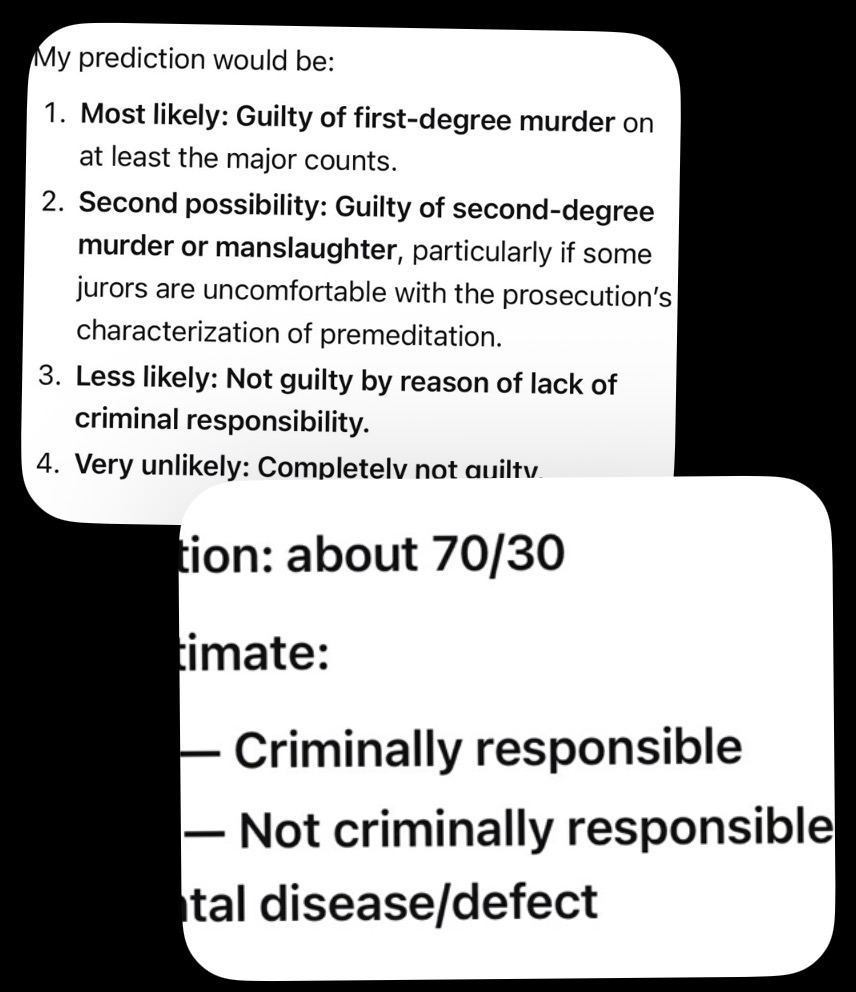
My colleague used the same question and formatting.
The response was noticeably different:
- First degree: Most likely
- Second degree: Possible
- Not criminally responsible: Less likely
- Not guilty: Very unlikely
The overall estimate was:
70% criminally responsible
30% not criminally responsible
At first glance, those numbers might not seem dramatically different. Both responses predicted that a finding of criminal responsibility was more likely than not.
But look at what happened underneath those percentages.
One response considered second degree the most likely outcome and described a finding of not criminally responsible as a very real possibility.
The other considered first degree the most likely outcome and viewed not criminally responsible as less likely.
That’s a meaningful difference.
And it raises a bigger question:
Why didn’t ChatGPT give us the same answer?
The short answer is that ChatGPT isn’t a database containing one predetermined answer to every question.
It’s generating an analysis based on the information available to it, the way the question is presented, the context surrounding the conversation, and the reasoning it applies to that particular response.
Even when two prompts appear identical to us, the underlying context may not be identical.
There can also be differences in the information each conversation has provided previously, how the model interprets ambiguous facts, which factors it considers most important, and how it weighs competing possibilities.
And there’s another important issue:
Percentages can make an AI answer look much more certain than it actually is.
The problem with asking AI for a percentage
When we ask ChatGPT:
“What is the likelihood of outcome A versus outcome B?”
we’re asking it to reason through uncertainty.
When we then ask:
“Give me a percentage.”
we’re asking it to convert that uncertainty into a numerical estimate.
That doesn’t mean the resulting number has the same statistical meaning as a probability calculated from a validated model or a large dataset.
A response of 65% doesn’t necessarily mean there is a scientifically established 65% probability that something will happen.
It’s an AI-generated estimate based on the reasoning available to the model.
That distinction is incredibly important.
This isn’t just a legal example
Our experiment happened to involve a trial, but the underlying lesson applies to almost every business decision where people are beginning to use AI.
Consider asking ChatGPT:
- Should we launch this product?
- Which customer segment should we target?
- Which marketing strategy is most likely to work?
- Should we increase our advertising budget?
- Which website redesign will produce more conversions?
- Should we bring SEO in-house or continue using an agency?
- Which competitor is most likely to take market share from us?
- What’s the likelihood that a particular campaign will succeed?
AI can be extremely useful in analyzing these questions.
But you shouldn’t confuse an AI-generated prediction with an objective fact.
AI is only as good as the context behind the question
This is one of the biggest things businesses need to understand as AI becomes part of everyday decision-making.
People often assume that AI eliminates subjectivity.
In reality, AI can expose a different kind of subjectivity: the assumptions and context used to arrive at an answer.
If you give an AI incomplete information, it has to fill in the gaps.
If the question contains ambiguity, it has to interpret it.
If there are competing explanations, it has to decide which ones deserve more weight.
And if you ask it to assign percentages to uncertain outcomes, it has to translate qualitative reasoning into numbers.
That can be incredibly useful.
It can also be incredibly misleading if you treat the output as certainty.
So should we stop using AI to make decisions?
Absolutely not.
In fact, the opposite is true.
AI can be an incredibly powerful decision-support tool.
The key is understanding what role it should play in the decision.
Instead of asking AI to simply tell you what will happen, use it to challenge your thinking.
Ask it:
What assumptions am I making?
What information am I missing?
What are the strongest arguments for each possible outcome?
What evidence would change your conclusion?
What would make your current prediction wrong?
Give me the strongest case against your own recommendation.
Those questions can produce much more useful analysis than simply asking, “What do you think will happen?”
The better way to use AI for business decisions
I like to think of AI as a strategic thought partner, not an oracle.
A good AI-assisted decision process might look something like this:
1. Give it the facts
Don’t make the model guess about the business, customer, market or situation.
Give it the relevant information.
2. Define the possible outcomes
If there are several possible decisions or scenarios, clearly identify them.
3. Ask it to identify assumptions
Have AI tell you what it is assuming that you haven’t explicitly provided.
4. Ask it to challenge itself
Don’t just ask for a recommendation.
Ask why the recommendation could be wrong.
5. Ask for probabilities carefully
Percentages can be useful for comparing relative likelihoods, but don’t mistake them for scientifically validated probabilities unless they’re based on an appropriate statistical model and data.
6. Compare multiple analyses
If the decision is important, run the question through different approaches or models and look for areas of agreement and disagreement.
And perhaps most importantly:
7. Apply human judgment
AI can process enormous amounts of information and identify patterns that humans might overlook.
It doesn’t replace experience, business context, accountability or judgment.
The real lesson from our little experiment
My colleague and I didn’t set out to prove that ChatGPT is unreliable.
Actually, our experiment demonstrated something more interesting.
AI can be remarkably useful while still being uncertain.
Those two things aren’t contradictory.
Both ChatGPT analyses agreed on the broad conclusion: criminal responsibility was more likely than not.
But they disagreed about the most likely specific outcome and differed in how they assessed the alternatives.
That’s exactly the kind of nuance that can disappear when someone takes an AI-generated answer at face value.
And this is where businesses need to become more sophisticated about AI.
The question isn’t:
“Can AI give me an answer?”
Of course it can.
The better question is:
“How much should I trust this particular answer, what assumptions produced it, and what should I do with it?”
That’s the difference between using AI and using AI intelligently.
AI shouldn’t replace expertise. It should amplify it.
We’re entering a period where virtually anyone can ask an AI system to analyze a business problem, develop a marketing strategy or predict an outcome.
That democratizes access to analysis.
But it doesn’t democratize judgment.
Knowing what to ask, what information to provide, how to evaluate the response, when to challenge it and when to ignore it is becoming a skill in its own right.
For businesses, that’s where AI strategy becomes much more than simply adding ChatGPT to the workflow.
The goal isn’t to have AI make every decision.
The goal is to make better decisions because you used AI well.
Leave a Reply